
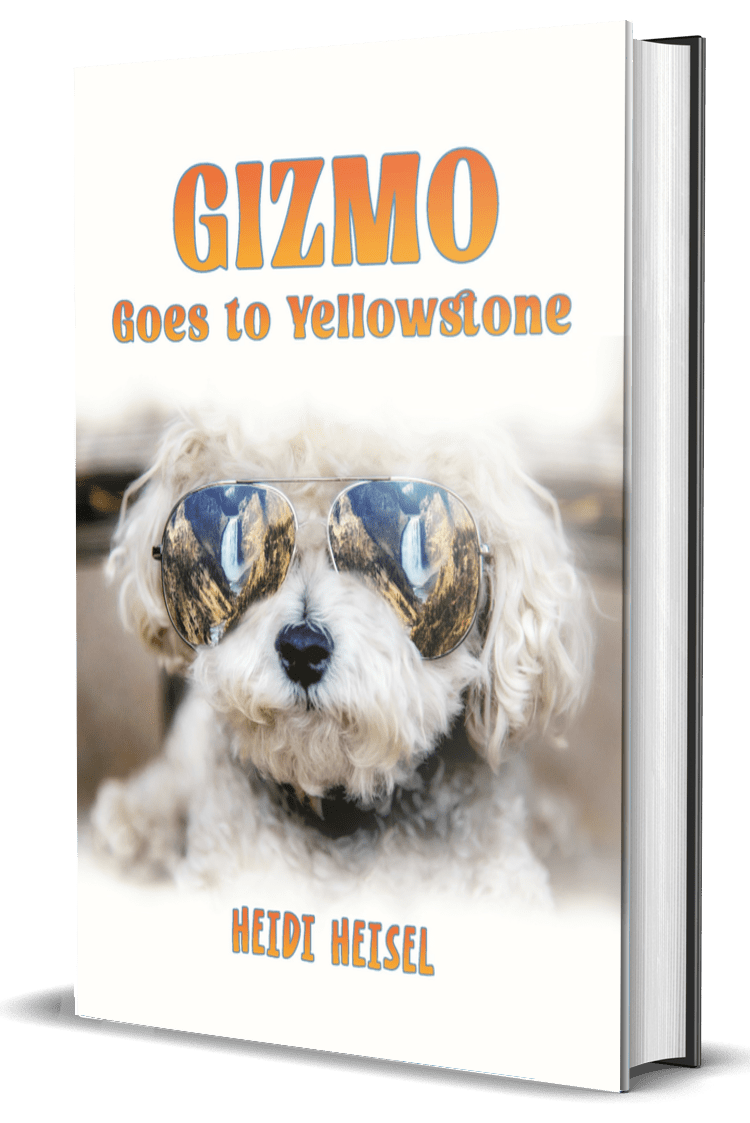
What makes us different can often feel like a flaw—especially for kids trying to make sense of their place in the world. In Gizmo Goes to Yellowstone, author Heidi Heisel and illustrator River Wilson take young readers on a journey that gently unpacks this idea. Through Gizmo, a small white dog on a big quest, we see that being different doesn’t mean being less. In fact, it can mean being exactly who you’re supposed to be.
From the very beginning, Gizmo notices something that sets him apart: he doesn’t have a tail. While his friends wag happily, Gizmo wonders what it would feel like to do the same. He doesn’t recall ever having a tail, but now he wants one—just to fit in.
So begins Gizmo’s heartfelt mission in Yellowstone National Park, a place teeming with animals of every kind. If anyone knows about tails, it’s the creatures of Yellowstone. Gizmo’s logic is simple: if he just finds the right tail, he’ll finally feel like he belongs.
The journey is playful and warm, as Gizmo meets antelope, deer, bison, birds, and even a wolf. Each animal proudly shows off their tail, and Gizmo tries to imagine how it might feel to have one like theirs. But something is always a bit off. The deer’s tail is too short, the bison’s too long, the bird’s made of feathers and meant for flight—not quite the fit for a grounded pup. He even finds a poofy bunny tail and tries it on, only to feel awkward and a little ridiculous.
What Gizmo doesn’t know is that all the animals are watching. They’re not laughing at him—they’re admiring his effort. They see a dog who’s kind, determined, and curious. And when a wise grizzly bear steps out from the trees near Old Faithful, he offers Gizmo something more valuable than a tail: perspective.
“You’re looking for a tail,” the grizzly says, “to be like all of your friends. But the truth is, you don’t need one to be special. What sets you apart is what makes you, you.”
This simple message carries deep meaning. In a world where kids often feel pressure to blend in, Gizmo Goes to Yellowstone offers a story about the joy and strength of embracing yourself. The book doesn’t solve Gizmo’s “problem” by giving him what he wants. Instead, it helps him see that he never needed it in the first place. That’s a powerful message for children—and one that sticks.
Parents and educators can use this story to talk about differences in many forms. Whether it’s physical appearance, learning style, personality, or background, kids are navigating a world where sameness is often praised. Gizmo reminds them that uniqueness is not something to fix—it’s something to celebrate.
The book is filled with beautiful illustrations and real-life photos from Yellowstone, giving it both emotional and educational depth. Kids can enjoy learning about wildlife while absorbing a message about self-worth. The rhyming verses are easy to read aloud, making it perfect for bedtime or classroom storytelling.
What makes Gizmo a great role model is that he’s not perfect. He doubts himself. He feels left out. He tries and fails. But he keeps going. And in doing so, he finds not a tail, but something even more important—self-acceptance.
By the end of the story, Gizmo walks proudly, tail or no tail. And young readers are left with the comforting truth that it’s okay to be different. In fact, it might be the very best thing about you.
So if your child has ever felt left out, unsure, or not quite like the others, let them walk beside Gizmo for a while. They may just discover, like he did, that sometimes the thing you think is missing is the very thing that makes you shine.